
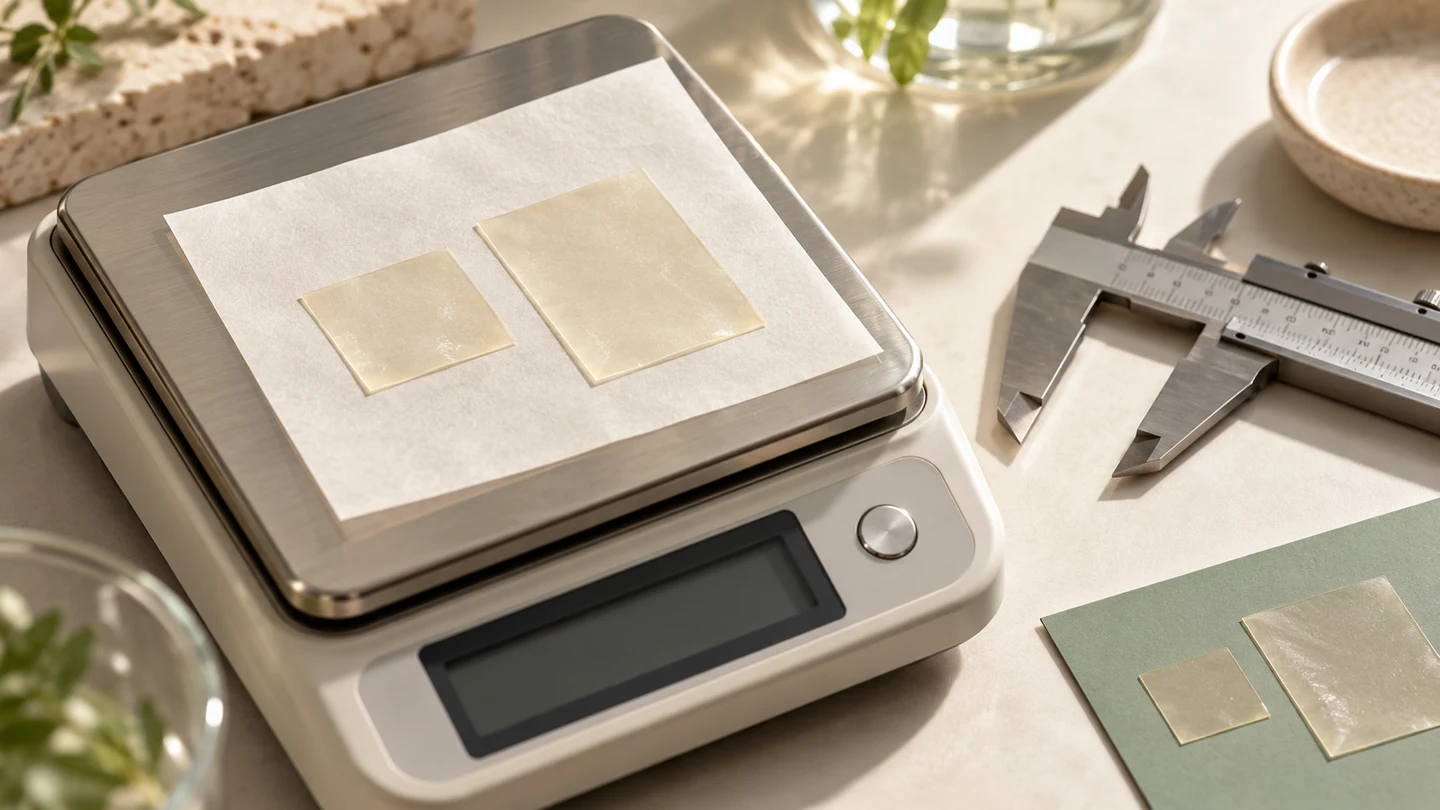
Film dimensions establish area, not ingredient capacity. A workable pet oral film specification connects dimensions, dry mass, ingredient content, handling and the analytical method used to measure the finished unit.
Calculate area without promising a payload
A 2 × 2 cm film has an area of 4 cm². A 2 × 3.5 cm film has an area of 7 cm², which is 75% larger. That arithmetic describes this site’s common and maximum development dimensions. It does not establish a 75% increase in usable ingredient content. Such a prediction would require comparable thickness, density and composition, as well as acceptable handling. A larger film also changes the unit presented to the animal and the space needed in a sachet. For an initial feasibility discussion, state the desired ingredient amount per finished unit separately from the proposed film size. Leave thickness and achievable loading open until the development team has evaluated the formula. A carton containing 20 or 30 strips says nothing about the amount in each strip.
Separate unit mass from ingredient content
Two films can weigh the same while containing different amounts of a selected ingredient. Mass measurements answer how much material is present; a suitable assay answers how much of the named component is present. FDA’s 2023 solid oral dosage case study discusses blend and content uniformity in drug manufacturing, including sampling and statistical assessment. It supports the distinction between a blend-level result and control of finished units. That pharmaceutical example does not certify a pet film or set its commercial limits. For a buyer’s specification, identify the component being measured, the reporting unit and the method’s suitability for the film matrix. A total batch average can hide differences between individual pieces. Ask the laboratory what the reported result represents before accepting a certificate as evidence of uniformity. FDA: risk-based blend and content uniformity assessment.
Write a specification that can be tested
An actionable specification names the sample, method and acceptance criterion for each property. The development team should decide which measurements belong at sampling, process qualification and commercial release. Avoid copying a tolerance from an unrelated tablet or human film simply because the number looks familiar. Where a method cannot distinguish the component from the carrier, improve the analytical approach before relying on its result. Record whether reported content is on an as-supplied or dry basis. Keep the retained sample and the laboratory report connected to the same batch identifier. A change in cutting dimensions or dry mass needs an assessment of ingredient content per unit, even when the ingredient list remains unchanged. Buyers can then compare successive batches using the same definitions and investigate differences without rebuilding the specification.
Buyer checklist
- State length and width in centimetres, and report thickness with its unit.
- Identify dry mass per film and the basis of calculation.
- Define ingredient content per unit separately from percentage by weight.
- Specify sampling locations, individual versus composite testing and the applicable analytical method.
Questions buyers ask
Does a larger film always carry more ingredient?
Only under stated assumptions. Area alone cannot predict feasible loading, handling or finished-unit performance.
Can a batch-average assay prove every strip is uniform?
A composite average does not reveal the spread between individual units. The sampling and testing plan must address the question the buyer needs answered.
Is USP compliance automatic for pet oral films?
No. Applicable standards depend on the product classification and market. A pharmaceutical reference does not by itself establish a pet nutritional product’s compliance.
References and scope
Sources checked on 23 October 2026. This is supplier-authored development guidance, not an independent clinical review. Calculations marked as examples are not product test results. Questions or corrections: info@hytanbio.com.
- FDA: risk-based blend and content uniformity assessment
- USP: Uniformity of Dosage Units, chapter 905