
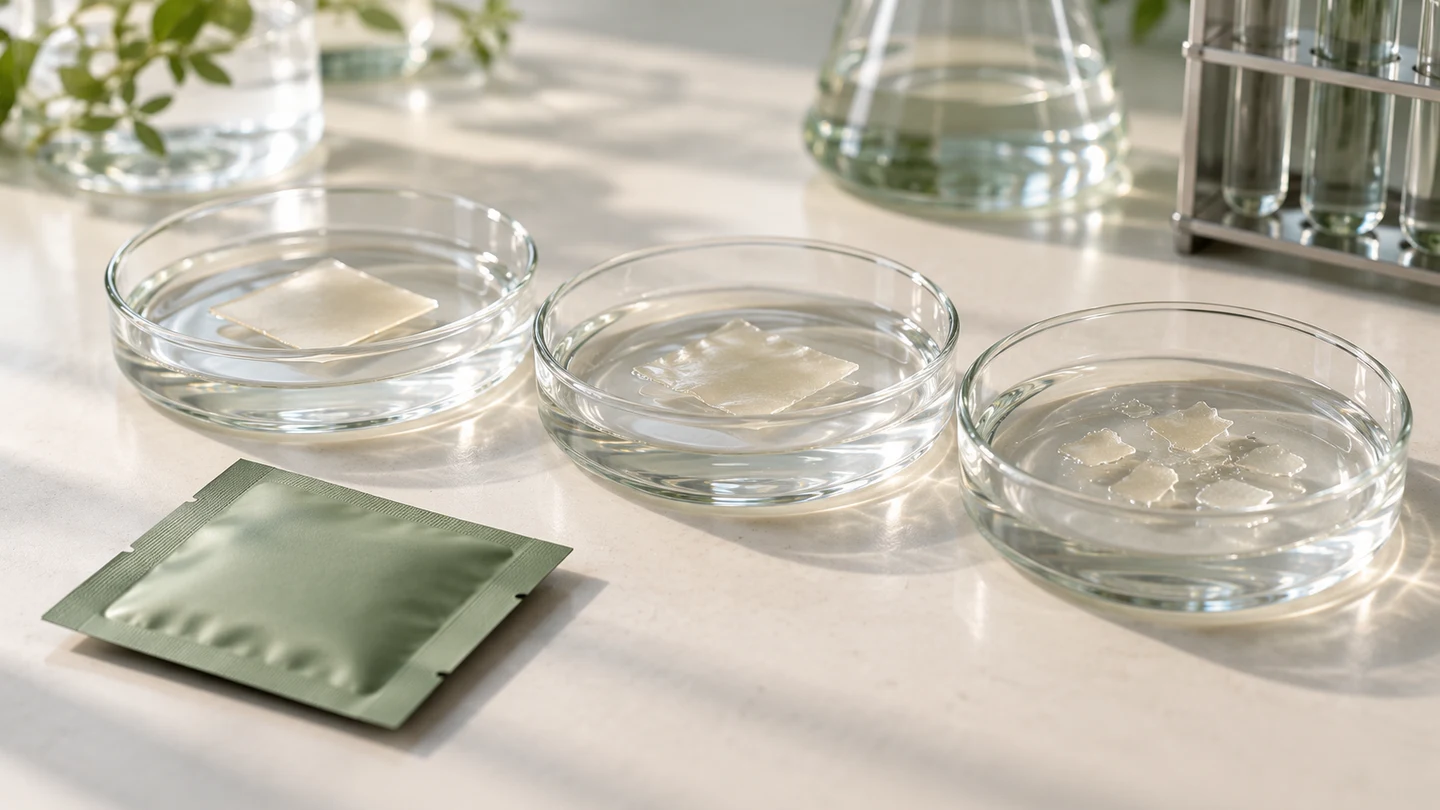
A pet oral film can break apart without every ingredient dissolving. Buyers should request the test method, a defined endpoint and individual results before comparing speed claims. A laboratory disintegration time alone cannot establish absorption or an effect in a dog or cat.
Separate the three questions in a performance claim
Disintegration describes the film breaking into smaller pieces. Dissolution concerns a specified substance entering solution. Absorption asks what reaches the animal's circulation, or another relevant site, after administration. These questions require different evidence. The European Medicines Agency separates disintegration and dissolution in its development guidance for veterinary medicinal products; that guidance is a technical reference here, not a declaration that a nutritional pet film is a veterinary medicine. A supplier video showing a sheet disappear into water can document an observation, but it does not measure an ingredient concentration in the liquid. Ask what the camera cannot show: whether material remained on the vessel, whether an insoluble component was expected and which ingredient the laboratory measured. Keep the finished formula and the test sample linked by batch number. Otherwise, a persuasive demonstration may describe a different film from the one being quoted. EMA: development pharmaceutics for veterinary medicinal products.
Make two supplier reports comparable
Write the comparison method before asking which sample is faster. For an exploratory screen, record the liquid composition and volume, temperature, movement, film dimensions, conditioning history and the way the sample enters the liquid. Describe the endpoint in words that two observers can apply consistently. First visible tearing, loss of the intact sheet and absence of visible residue can produce different times for the same sample. Request individual observations as well as a summary, and agree how an incomplete test is reported. A proposed internal screen with six strips might show five reaching the endpoint and one remaining intact at the stopping time. Reporting only the five completed measurements would hide that result. Six is an example for discussing a protocol, not a validated sample size or a universal release requirement. Record deviations before interpreting the comparison.
Link the test to development and storage decisions
Use the agreed method to compare the versions your team actually needs to choose between, such as two film thicknesses or a flavor change. Keep a reference sample so the laboratory can distinguish a formula effect from a change in the test setup. Repeat the relevant measurements on stored samples in their intended packs; a result from a freshly made sheet does not describe the entire shelf life. Health Canada's veterinary drug quality guidance lists disintegration among potential solid oral product tests and ties specifications to the product being developed. Its medicinal-product requirements should not be copied wholesale into a pet food brief. For nutritional films, agree a fit-for-purpose performance specification with the laboratory and the responsible market reviewer. Any statement about faster absorption still needs separate evidence relevant to the species and finished formulation. Health Canada: veterinary drug product quality requirements.
Buyer checklist
- Identify the film batch, formula revision and packaging history.
- Name the measured endpoint and any ingredient assay.
- Record medium, temperature, agitation and sample dimensions.
- Request individual observations, failures and deviations.
- Keep absorption and efficacy claims outside a breakup-time comparison.
Questions buyers ask
Does a faster dissolving film work faster?
A disintegration result cannot answer that question. The intended effect, ingredient delivery, animal species and finished formulation require their own evidence. Avoid converting a physical test time into a clinical claim.
What disintegration time should we specify?
There is no single time established here for all pet oral films. Agree the endpoint and method first, then set a justified criterion for the intended formulation and use.
Can we compare a water test with a saliva-based test?
Only with a documented rationale. Different media and test conditions can change the observation. Report each method separately until comparability has been demonstrated.
Should the report include unsuccessful strips?
Yes. The planned reporting rules should retain incomplete observations and deviations. Excluding them can make a variable batch appear more consistent than it was.
References and scope
Sources checked on 30 October 2026. This supplier-authored guide supports project discussions; it is not an independent clinical review or a market authorization. Suggested exercises and numerical examples are not HYTANBIO batch results. The editorial image was generated for this guide. For questions or corrections, contact info@hytanbio.com.
- EMA: development pharmaceutics for veterinary medicinal products
- Health Canada: veterinary drug product quality requirements