
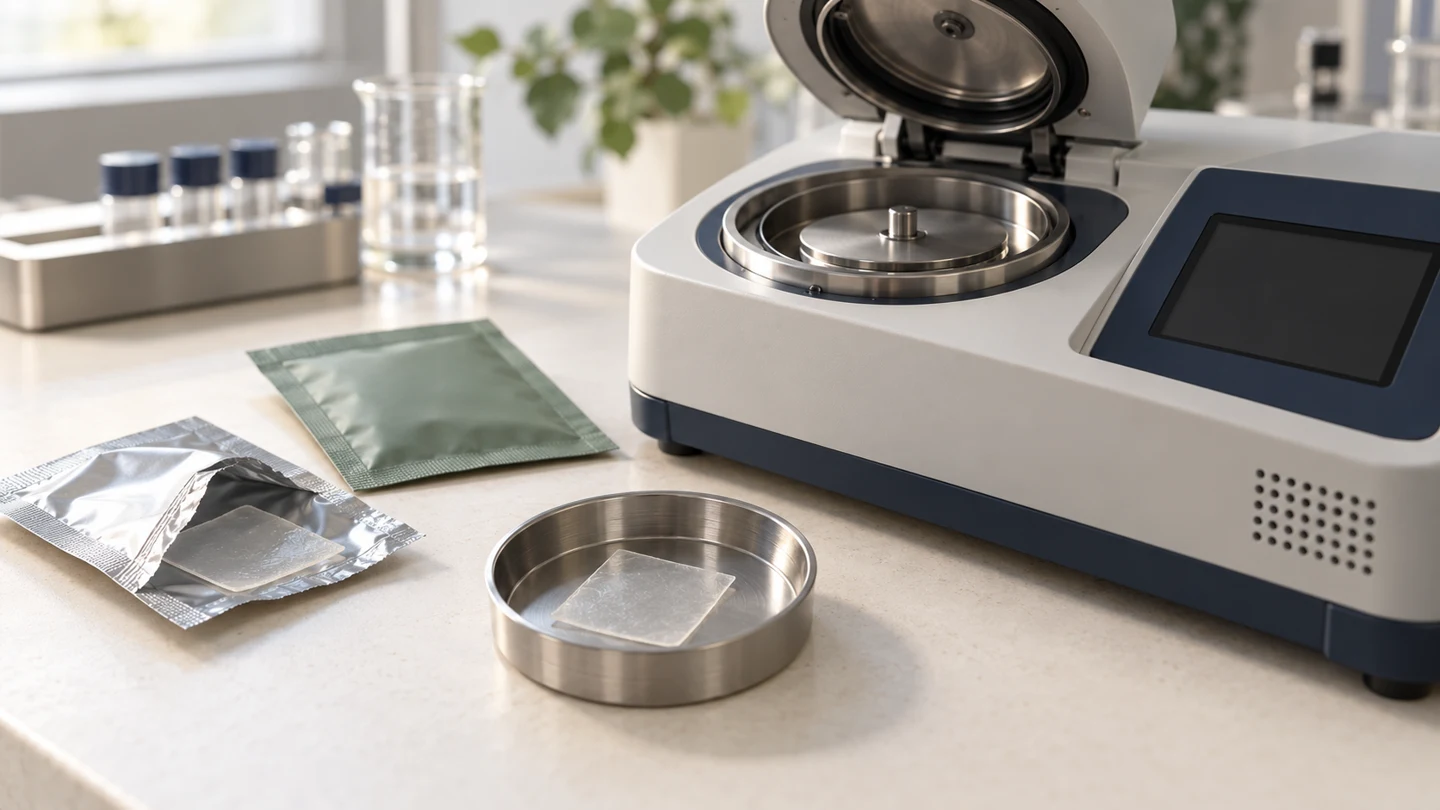
Moisture content and water activity answer different questions. A pet oral film buyer needs both the measurement definition and the sample history before using either result to approve a batch or compare packaging.
Read the units before comparing results
Moisture content describes the amount of water in a material and is commonly reported as a percentage on a stated basis. Water activity, written as aw, is a ratio rather than a percentage of the film’s mass. FDA’s technical guide explains the relationship aw = equilibrium relative humidity divided by 100. An equilibrium relative humidity of 50% therefore corresponds to aw 0.50 under the measurement conditions. That calculation does not mean the film contains 50% water. The guide dates from 1984; its definition is cited here, not its historical instrument recommendations. On a supplier report, look for the test name, reporting basis and temperature. A result labeled only “moisture: 0.50” is too ambiguous to approve. Ask the laboratory to clarify the property and unit before comparing it with another batch. FDA: Water Activity (aw) in Foods, technical guide dated 16 April 1984.
Treat published categories as context, not a release limit
FDA’s July 2022 Guidance for Industry #245 groups animal foods by water activity: above 0.85, between 0.60 and 0.85, and below 0.60. These are broad categories used in its food-safety discussion. They do not prescribe a universal acceptance range for pet oral dissolving films or establish the shelf life of a particular formula. A commercial specification must identify the finished product, intended market and evidence supporting its limits. Ask the manufacturer which decision each measurement supports and who approved the criterion. If the answer is simply that a value falls into a published category, the product-specific justification is still missing. Keep physical handling, ingredient stability and the food safety assessment as separate review items. A water activity reading alone cannot stand in for all of them. FDA CVM Guidance for Industry #245, July 2022, section 4.5.3 and Table 4-7.
Compare samples with the same handling history
A difference between two reports is easier to investigate when both samples have a documented history. Record the formula revision, batch number, sachet material and whether the film was tested after opening or taken from an intact retained pack. Also record the interval between opening and analysis. Ask the laboratory whether the methods, measurement temperatures and sample preparation were comparable. If these details are missing, request clarification before blaming the packaging or changing the formulation. An apparent trend based on unlike samples can send development work in the wrong direction. For a repeat-order review, retain the original report alongside the new result and document any method change. The quality team should decide whether additional matched-sample testing is needed, using the question being investigated to define the comparison.
Connect the report to the film and its sachet
For a packaging decision, agree on observations that describe the customer’s actual handling task: opening the sachet, removing an intact film and following the approved directions. Check those observations against the same formula and pack revision represented in the analytical report. If a retained sample sticks, tears or looks different, document the observation without assuming water activity caused it. Investigate the material and storage history as well. This site’s common development format is 2 × 2 cm, with a maximum of 2 × 3.5 cm subject to feasibility and cartons of 20 or 30 strips. Those dimensions and counts are not evidence of moisture protection. A sachet specification and a product stability assessment should support any storage statement. Changes to the film or pack need a documented review before carrying an earlier conclusion forward.
Buyer checklist
- Identify moisture content and water activity as separate report fields.
- State the moisture reporting basis, method identifier and measurement temperature.
- Trace the sample to a formula, batch and packaging revision.
- Record whether the sachet was intact and when the sample was opened.
- Ask for the product-specific rationale behind each acceptance limit.
- Link any investigation to retained samples and the approved storage statement.
Questions buyers ask
Can two films with the same moisture percentage have different water activity?
Yes. Total water and its interaction with the material are different properties. Compare measured results for the actual formulations rather than converting a moisture percentage into water activity.
Does a low water activity result prove the film is sterile?
No. Water activity is a material property, not a sterility test. It does not replace the manufacturer’s applicable food safety controls or microbiological assessment.
Can the supplier set shelf life from one water activity reading?
One reading describes one sample under stated conditions. A shelf-life conclusion needs evidence for the finished formula in its intended package over the relevant storage period.
Should the lowest possible water activity be the development target?
Use a justified product specification. The development team must evaluate the finished film’s handling, ingredient stability and safety requirements together; a lower isolated number is not sufficient evidence of a better product.
References and scope
Sources checked on 24 October 2026. This is supplier-authored development guidance, not an independent clinical review. Calculations marked as examples are not product test results. Questions or corrections: info@hytanbio.com.
- FDA: Water Activity (aw) in Foods, technical guide dated 16 April 1984
- FDA CVM Guidance for Industry #245, July 2022, section 4.5.3 and Table 4-7